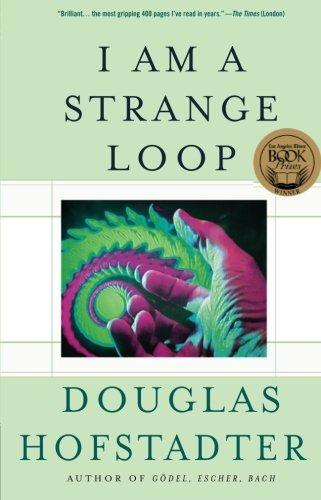

I Am a Strange Loop

436 pages

English language

Published July 8, 2008

ISBN:
978-0-465-03079-8
Copied ISBN!

View on OpenLibrary

View on Inventaire

I Am a Strange Loop is a 2007 book by Douglas Hofstadter, examining in depth the concept of a strange loop to explain the sense of "I". The concept of a strange loop was originally developed in his 1979 book Gödel, Escher, Bach.

In the end, we are self-perceiving, self-inventing, locked-in mirages that are little miracles of self-reference. Hofstadter had previously expressed disappointment with how Gödel, Escher, Bach, which won the Pulitzer Prize in 1980 for general nonfiction, was received. In the preface to its 20th anniversary edition, Hofstadter laments that the book was perceived as a hodgepodge of neat things with no central theme. He states: "GEB is a very personal attempt to say how it is that animate beings can come out of inanimate matter. What is a self, and how can a self come out of stuff that is as selfless as a stone or a …

4 editions

None

I expected a very deep dive into what exactly a strange loop is and how it pertains to consciousness, that's not really what this book is. While it does somewhat deliver on the promise, it's also in a very autobiographic style. By the end of the book you will have a fairly clear image of what Hofstadter's upbringing was like, what his values are and how he thinks about a wide range of stuff that's not strictly relevant to the main theme of the book, but part of the style in which he explains things.

In my opinion, the style works and I find the ideas presented convincing and very interesting. My main qualms with the book is that I don't feel counter-arguments are represented in a fair way (I don't know enough about the dualistic views presented to say exactly what, but they were never presented as having a …

Review of 'I Am a Strange Loop' on 'Goodreads'

The author's key strength is his ability to effectively explain complex topics in layman's terms using analogies. That helps a lot in this book, considering its complex topic - Consciousness. I found myself almost always agreeing with the author's idea about the existence/non-existence of the 'self'. Since I am not well-read on this topic, I will reserve from commenting too much on the topic of the 'self'. Instead, I will say that the author does a decent job of presenting the arguments objectively. And this is quite hard to achieve for a complex philosophical topic while keeping the text light and understandable.
The only minor complaint I have was that towards the end there are some sections - talking about musical tastes and their relation to the idea of self - that I found a bit out of place. I would not hold this against the author as the rest …

Review of 'I Am a Strange Loop' on 'Goodreads'

Sono in molti ad avere comprato Gödel, Escher, Bach. Parecchi l'hanno anche letto :-). Dopo più di un quarto di secolo, Douglas Hofstadter ha pensato di pubblicare questo sequel, se mi consentite l'uso del termine. In effetti di Bach e di Escher non si parla, né ci sono i dialoghi (tranne due agli estremi del libro): Hofstadter si concentra su Gödel, e parte dal suo famoso teorema - di cui viene data una spiegazione lunga, ma assolutamente cristallina - per arrivare alla sua definizione di "intelligenza", che si può più o meno riassumere come "un sistema raggiunge l'intelligenza quando riesce a creare degli «anelli nell'Io» (gli «strange loops» del titolo), vale a dire una rappresentazione interna di sé stesso, a un livello di codifica differente da quello usuale".
Personalmente mi rimangono dei dubbi sulla sua filosofia "sepolcriana" (nel senso di Ugo Foscolo): il libro però è sicuramente interessante, oltre …

avatar for oobisan@bookwyrm.social

rated it

avatar for emme

rated it