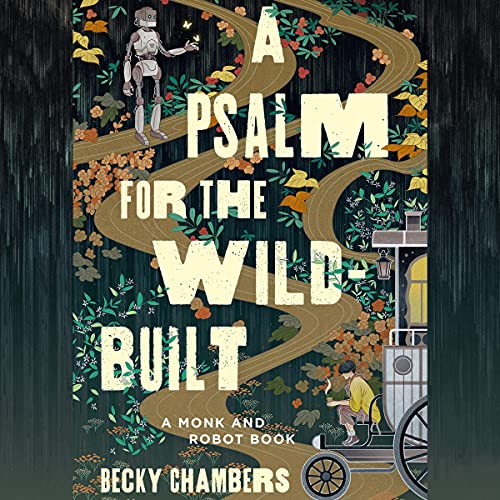
It's been centuries since the robots of Panga gained self-awareness and laid down their tools; centuries since they wandered, en masse, into the wilderness, never to be seen again; centuries since they faded into myth and urban legend.
One day, the life of a tea monk is upended by the arrival of a robot, there to honor the old promise of checking in. The robot cannot go back until the question of "what do people need?" is answered.
But the answer to that question depends on who you ask, and how.
They're going to need to ask it a lot.
Becky Chambers's new series asks: in a world where people have what they want, does having more matter?
It's been centuries since the robots of Panga gained self-awareness and laid down their tools; centuries since they wandered, en masse, into the wilderness, never to be seen again; centuries since they faded into myth and urban legend.
One day, the life of a tea monk is upended by the arrival of a robot, there to honor the old promise of checking in. The robot cannot go back until the question of "what do people need?" is answered.
But the answer to that question depends on who you ask, and how.
They're going to need to ask it a lot.
Becky Chambers's new series asks: in a world where people have what they want, does having more matter?
I read the Monk and Robot series over a couple of days last year when I was feeling stressed and a little burned out, and they were exactly what I needed.
As other reviewers have already said: it is a truly gentle, hopeful, beautiful story about connection and self discovery and communication. It's got a post capitalist, solarpunk vibe of a world I'd love to inhabit, an appreciation for little pleasures and little deals, loveable characters, and it's also insightful and wise. Plus the main character rides a bicycle as their main form of transportation!
I now want to leave it all and become a wandering tea monk with a bike. That's how perfect this book is. Loved it.
As other reviewers have already said: it is a truly gentle, hopeful, beautiful story about connection and self discovery and communication.
It's got a post capitalist, solarpunk vibe of a world I'd love to inhabit, an appreciation for little pleasures and little deals, loveable characters, and it's also insightful and wise.
Plus the main character rides a bicycle as their main form of transportation!
I now want to leave it all and become a wandering tea monk with a bike.
That's how perfect this book is.
Loved it.
Solarpunk tale of self-discovery and grappling with one's history
5 stars
A compelling yet soothing tale about a non-binary monk having a midlife crisis.
Topics: finding purpose in life, wilderness, the nature of consciousness, and more.
No violence, no struggle apart from that of a person against the pressures of exertion and survival outside of human civilization, and yet it is a page-turner.
It gets the "solarpunk" label because the setting is a human society which fits the bill: non-capitalist, low-impact technology. Main transport method: "ox-bikes," apparently the author's neologism to refer to electronically assisted bicycles that pull carts around. Personal computers are computers that last a person's entire life. Half of the available land is set aside for wilderness. Etc.
100% recommend. It would probably be a good introduction to science fiction for someone who's not familiar with the genre as it exists in the 21st century.
A compelling yet soothing tale about a non-binary monk having a midlife crisis.
Topics: finding purpose in life, wilderness, the nature of consciousness, and more.
No violence, no struggle apart from that of a person against the pressures of exertion and survival outside of human civilization, and yet it is a page-turner.
It gets the "solarpunk" label because the setting is a human society which fits the bill: non-capitalist, low-impact technology. Main transport method: "ox-bikes," apparently the author's neologism to refer to electronically assisted bicycles that pull carts around. Personal computers are computers that last a person's entire life. Half of the available land is set aside for wilderness. Etc.
100% recommend. It would probably be a good introduction to science fiction for someone who's not familiar with the genre as it exists in the 21st century.
The prose is powerful. The attention to detail, opens up our imaginations towards the possibilities of a solarpunk world. High tech only when needed. We're not the center of the cosmos.
This is the kind of science fiction that makes me hopeful. Makes me sad as well. Sad that I will not live to see this world, but it could have been different, if history were to take a different course.
I wish the book was longer. I want to become a tea monk. I want to be a robot that stares at stalagmites for 30 years in a row.
There's a sequel, I know. But I wish there were a thousand sequels.
I can see now why this is a genre defining book, not because it has a solarpunk setting, but because, by existing, it is bringing those ideals and feelings into the real world. This book is a much needed respite for anyone feeling restless, tired or adrift. If you are trying to read something but don't have the effort, this is the book you are looking for
I can see now why this is a genre defining book, not because it has a solarpunk setting, but because, by existing, it is bringing those ideals and feelings into the real world. This book is a much needed respite for anyone feeling restless, tired or adrift. If you are trying to read something but don't have the effort, this is the book you are looking for
Review of 'A Psalm for the Wild-Built' on 'Goodreads'
3 stars
I wanted to read this because I had heard about this genre of “hope punk” or “cozy punk,” and I was curious. As I expected, there was no real conflict, or any jeopardy or much in the way of stakes. But this is what the genre is about, giving a break from the catastrophe that is our current world, so on that count, I would give it a high score, but I prefer novels with more at stake and more conflict. But I can see how many who are very stressed in everyday life and stressed about the planet and technology might take comfort in this sort of a book (not that I’m not stressed about these things, but I guess I’m used to higher level of stress). I don’t expect to continue with the series, but who knows?
My first Becky Chambers book, and I think I finally understand the enthusiasm. Wonderful developing relationship between Dex and Mosscap, lots of nature, and woven throughout the story, and increasing towards the end, the struggle to find meaning in life.
Despite living in a utopia, a dissatisfied monk embarks upon a journey of self-discovery, illuminated by a charmingly inquisitive robot. Felt like a perfect cup of tea, served by a best friend with a warm embrace. This is #solarpunk.
First a disclaimer: at this point I think a Becky Chambers book would have to be pretty terrible to get a bad review from me.
This is very clearly a novella, and continues Chamber's trend away from plot driven fiction as seen in the later Wayfarer books. So, not much happens, but deep themes are explored.
The solarpunk aspect has been remarked elsewhere, but I didn't expect was how much it seemed like a reflection on the (privileged) human condition. As a fellow privileged human, I recognized some of Sibling Dex's disquiet.
First a disclaimer: at this point I think a Becky Chambers book would have to be pretty terrible to get a bad review from me.
This is very clearly a novella, and continues Chamber's trend away from plot driven fiction as seen in the later Wayfarer books. So, not much happens, but deep themes are explored.
The solarpunk aspect has been remarked elsewhere, but I didn't expect was how much it seemed like a reflection on the (privileged) human condition. As a fellow privileged human, I recognized some of Sibling Dex's disquiet.
Review of 'A Psalm for the Wild-Built' on 'Goodreads'
3 stars
I loved the setting of this book. This is a world where monks travel on bicycles pulling wagons behind them. They come into towns and set up small tea stations. They serve the exact tea blend that a person needs to help with their emotional needs. The service is a mix of therapy and just having a quiet space to sit and think for an hour. It is very peaceful.
Sibling Dex has worked hard to become the best tea monk. However, it isn’t satisfying them in the way that they thought it would. They want to take a side trip out into the wilds to an abandoned monastery they heard about. On the way, they meet a representative sent from the robots. Robots gained autonomy generations ago. They left human areas and haven’t been heard from since. Now one has been sent to see what is going on with …
I loved the setting of this book. This is a world where monks travel on bicycles pulling wagons behind them. They come into towns and set up small tea stations. They serve the exact tea blend that a person needs to help with their emotional needs. The service is a mix of therapy and just having a quiet space to sit and think for an hour. It is very peaceful.
Sibling Dex has worked hard to become the best tea monk. However, it isn’t satisfying them in the way that they thought it would. They want to take a side trip out into the wilds to an abandoned monastery they heard about. On the way, they meet a representative sent from the robots. Robots gained autonomy generations ago. They left human areas and haven’t been heard from since. Now one has been sent to see what is going on with humans since they left.
This is like an alien first contact story. Neither the robot or the human has ever met a representative the other other type. They don’t quite know what to do with themselves.
This book is quiet. There isn’t a huge amount of plot. They travel together for a while. They don’t even meet other humans yet. There is a second book in the series that should cover what happens when Mosscap the robot meets other humans.
Read this one if you want to quiet, small story that is a slice of life on a planet that was once industrialized and has changed its ways.
There isn’t much I can add to loppear@bookwyrm.social’s review; once again, Chambers is simply wonderful. Here, she is running with the wholesome if slightly insipid promise for the future Solarpunk holds to explore human condition and (not entirely incidentally, I suspect) thumb a very long nose at the whole “machine uprising” crowd. I don’t know how someone can be so relentlessly, melancholically upbeat, but I do know I had to finish this before work, and that I had a little happy cry when I did.